The Polycrisis
How to Face Teaching in 2026

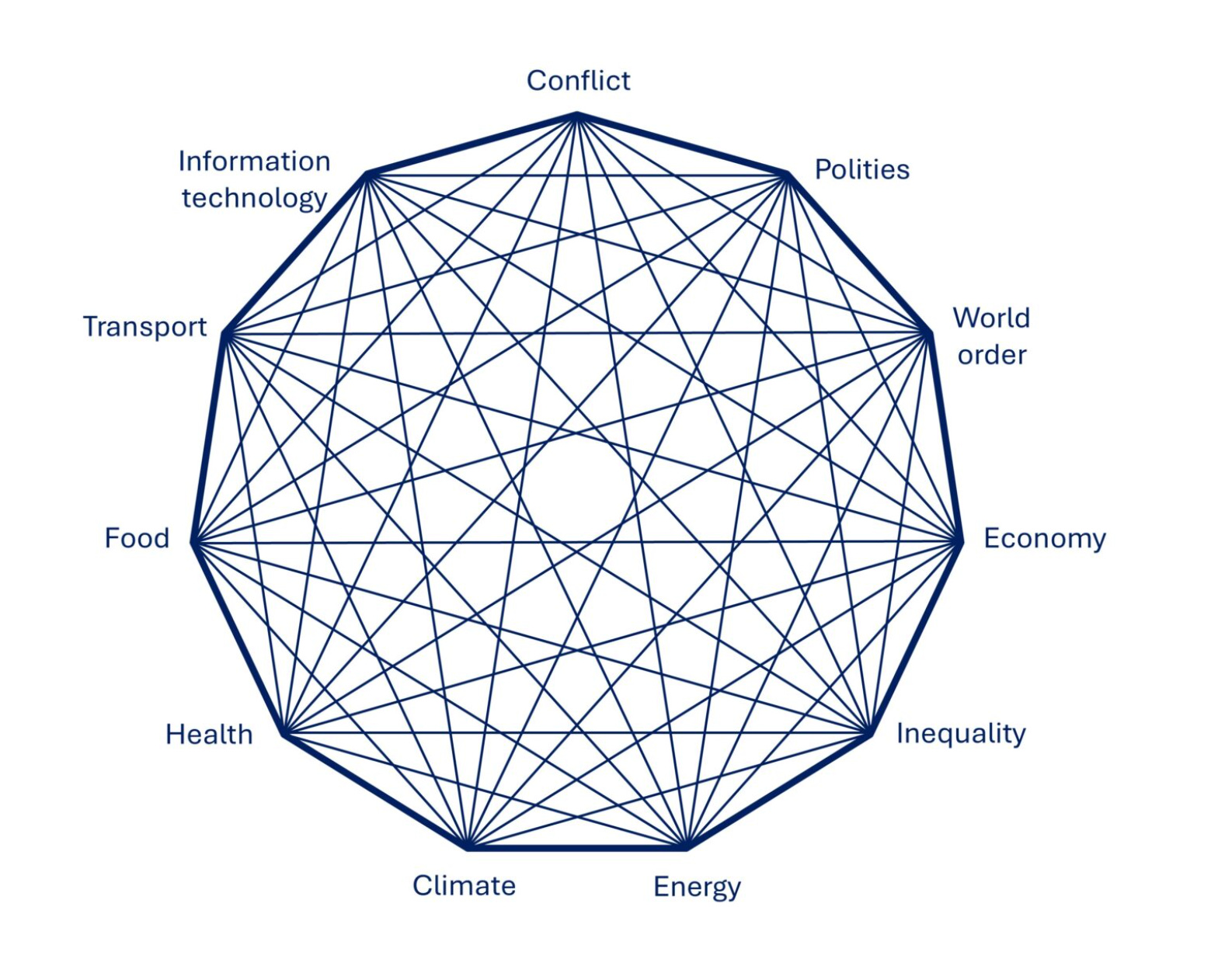
Image from the Cascade Institute
I first encountered the term polycrisis through an article I can no longer track down, in the context of education and morality, though I have now learned that the term has been around since the 1970s. No surprise! So have the crises.
I feel so deeply that what we are facing is a polycrisis: of planetary survival. Of decency. Of democracy. Of hope. Of meaning. Of the relationship to technology. Of the future. Of our food, health, wellbeing and fears. Of our isolation and loneliness. Some of this is part of the human condition. Some comes from the capitalist structures that dominate our daily lives. Some comes from the nature of relatively recent (two-century-old) nationalism. Some is from colonialism. Some comes from the Great Acceleration, the convergence of agriculture and transportation and energy that has been accelerating since after the Second World War and is evident in our anthropocene. Some comes from increasing inequality, and the greed of the billionaire class with their mega yachts and tax havens. Some comes from recent (TV) and more recent (Internet, cell phones, social media, videos, algorithm) tech changes. And some comes from the US descent into fascism.
In other words, some of these challenges have been around a long time, and some are new.
But all are real.
We all see it converge in discourses about education: students don’t read; students use AI to do their work (because they don’t care and the stakes are high). Students are going through the motions. The public has lost confidence in education, and while K12 and higher ed have some differences (K12 is often mandatory and sometimes publicly, even if unevenly, funded), the multiple and sometimes contradictory aims of institutional schooling apply to both. (School is for democracy; school is for character development; school is for job preparation and social capital; school is for social mobility—for some.)
I’ve written about much of this.
And some of it is age-old laments, like the Socrates dialogue about the dangers of writing (it’s great stuff. Makes McLuhan look like a plagiarist lol).
This semester I’m teaching two apparently unrelated courses: What Should We Eat? and Zoom Text Talk Insta Sing Chat: Modalities and Media of Interaction. In both, the goal is to help students develop a deeper sense of analysis of and connection for things they usually take for granted: food and communication technology. (This holistic and systemic approach, with deep observation, is the superpower of anthropology, as I see it.)
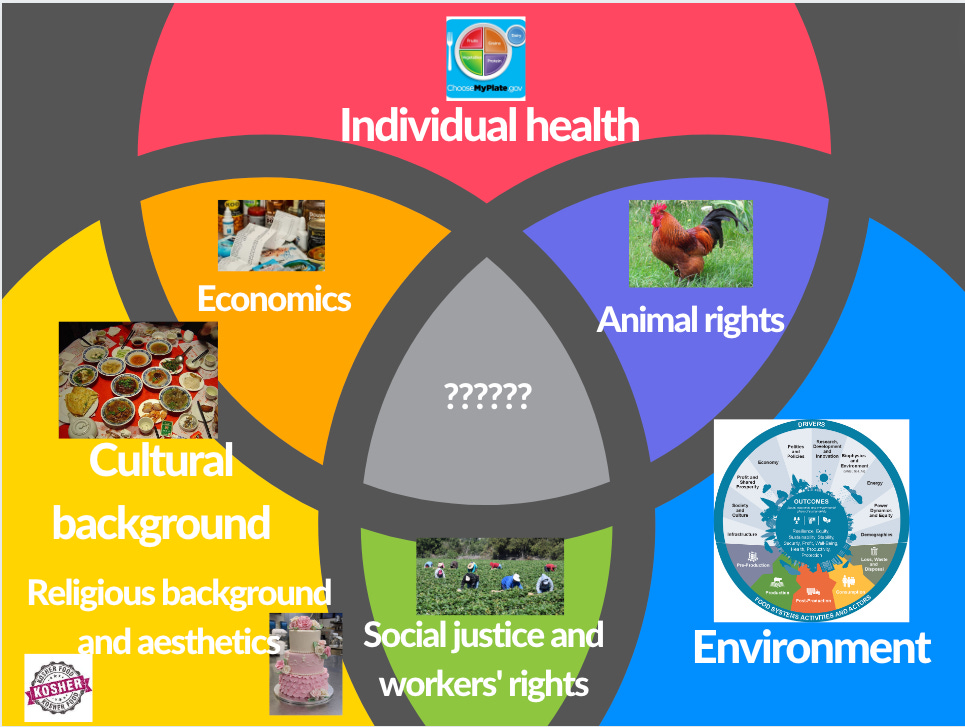
I constantly fight against the schoolish expectations of my high-achieving students, who know the recipe for succeeding in school: Do whatever tasks Canvas says. Use the rubric for writing. Read what will be tested. Get the PowerPoints and read them. Memorize for tests. Go to class if it’s required. Shop or watch TikToks while the professor is lecturing. Save your energy for internships, service items on your resume, clubs, working out, social life. (This is an almost completely residential campus where almost no students fall outside the traditional age range of 18 to 22. Students at other types of institutions have different emphases, which usually include much employment and care responsibilities, as well as many worries about housing, food, health, money.) I do not blame the students at all. In fact, I feel deep concern and compassion for them. I blame the system.
But for whichever type of student, in 2026 there is widespread and deep anxiety and uncertainty about the world our students will continue to inhabit. I do not fault them for failing to come wholly ready to engage with my class, which is, after all, only one of about a dozen categories of activities that they are keeping track of.
I am at the very last day of our three-week winter break and I’m still not rested. I am exhausted after a personally very challenging year in addition to the national and global assaults on decency and order. How can I get myself to gear up for this coming term?
And what can my little courses contribute to the solving of the polycrisis?
In terms of my pedagogy, developed gradually over more than twenty years of research, writing, experimenting, and soul-searching, these are my general principles:
My focus is on students’ learning, which also necessitates their wellbeing
I aim to create a community of learners where students develop confidence at their ability to learn independently and also interdependently
Nobody knows everything, other than relatively limited types of knowledge within a defined domain
Students have different experiences entering the class and different goals after they leave the class. Shouldn’t they be allowed different experiences in the class?
I never use grading to threaten or coerce
I do not see myself primarily as a judge
I see myself as a more experienced ally, mentor, coach, elder, helping to initiate my younger charges into the world, beyond the one they already know. For the younger ones, they scarcely have even outside their parental or familial cocoon. For the older ones, they have the university cocoon which has shown them a curated version of the world.
In the context of my anthropology courses, knowing that few students will ever become anthropologists, I hope to show them that…
Everything connects
There are moral and ethic concerns about everything
We have tools for analyzing
Things are not always what they seem
Learning is an adventure
There are lots of different ways to live. Our way is just one, and maybe not the best one
Learning with others is exhilarating
Not everything has to be part of competition
But this semester, beginning as I am, and as perhaps some of them are too, in a state of depletion, my goal is going to be to do as little as possible but to make everything count. This is fighting my tendencies of adding lots and lots of readings and activities; wish me luck.
If our students are distracted, well, so am I.
So we will focus through our in-person gathering, inspired by Priya Parker.
If there is too much to read, well, let’s find the single essential key to everything.
I have learned about the concept of threshold concepts, introduced by Jan Meyer and Ray Land in 2003, those transformative levers that make everything evermore different, as when people realize that conversations have structure, or that agriculture is not just plowing uniform crops onto empty fields plus fertilizer. Threshold concepts are transformative, irreversible, integrative, bounded, even troublesome. Students may need guidance to discover them and to really internalize them; a ChatGPT summary will not suffice.
My goal this semester is to focus on these threshold concepts. Of course specific facts and knowledge are needed, and they can be fascinating, but they are in the service of the big picture.
And the big picture is the polycrisis. Wicked problems. Holism. Deep structures.
Let’s go.
I really appreciate this piece! A number of years ago, as I was transitioning away from assigning meaningless homework, I made the conscious choice to strip away as much busywork as I could and solely focus on the essentials. It was the best pedagogical decision I’ve made. Since then, I try to instill this mindset in my young students, reiterating that when I give them work, it’s important and I want them to do their best. Thank you for sharing! Good luck this semester!
Thank you for this post! I love this term polycrisis, and feel this so deeply. I appreciate your focus on doing less and focusing in on the most crucial understandings. I don’t see any other way forward for educators. We simply aren’t machines that can process unlimited changes / learning simultaneously. Your language of depletion really connects to me, too— this is the same metaphor I used to introduce my Substack about educator burnout: interested in your feedback!
https://open.substack.com/pub/regenerativeschools/p/welcome-to-regenerative-schools?r=6kxkx2&utm_medium=ios&shareImageVariant=overlay